Write the late-fee rule once. Stop renegotiating it every month.
A late fee that changes every time you text a renter isn't a policy. Grace windows, reminders, and a fixed fee — separate from failed-card retries.
By DrumFleet · · 4 min read
The Saturday text is almost always the same.
"Hey, rent hit last week and I forgot — can you wait till Friday? I'll Venmo."
You say yes, because they're a good renter and the washer is still in the closet. Next month it's the same text, a little later. By month four you're negotiating the fee every time, and the fee is whatever you feel like typing while you're standing in a parking lot.
That isn't a late-fee policy. That's a mood.
Late is a definition, not a feeling
A working rule answers three questions before anyone is late:
- How many days after the due date before the payment is late?
- What does "late" cost, in dollars, once?
- Who gets told, and when — before you personally start typing?
If those answers live in your head, they change with how busy you are and how nice the renter sounded. If they live in the agreement and in the tool that runs autopay, they don't.
Our washer and dryer rental agreement template has a late-payment section for a reason. Operators who use a structure like that usually pick a short grace window and a flat fee they can defend — something like five days and twenty-five dollars — then stick to it. We're not telling you what your numbers should be. That's between you, your attorney, and your state. The point is that the numbers exist before the first awkward text.
Reminders are not the same as chasing
Chasing is you, on a Saturday, typing "hey just checking in." Reminders are the system telling the renter the due date is coming, or that the grace window is about to end, without you becoming the villain in the thread.
Renters respond better to a boring automated note than to a personal plea from the person who installed the dryer. You already know this if you've ever had to decide, mid-conversation, whether to threaten a late fee you never wrote down.
Automatic payment reminders exist so the policy can speak for itself. You set them once. They fire on the schedule you chose. You stop reinventing the wording every month.
This is not the failed-card ladder
Easy to mash these together. They're different jobs.
- Late-fee policy = what "late" means, what it costs, and how renters get reminded. Grace, fee amount, reminder timing.
- Failed-card ladder = what happens when the card on file declines. Retry, flag, day 0 / 3 / 7 contact inside the grace window you already set.
We wrote about the ladder separately: Failed cards and the dunning ladder. Don't retell that story here. You need both. A fee with no retry path sits on a dead card. A retry path with no fee teaches renters that "later" is free.
What goes wrong when the rule is verbal
Three patterns we see over and over:
The friendly waiver. You forgive the fee once because life happens. Then twice. Then the renter treats the waiver as the real policy, and the next new renter hears about it from a friend in the building.
The different fee. Twenty-five for one person, ten for another, nothing for the property manager's cousin. When two renters compare notes — and they will — you look arbitrary. Arbitrary is harder to collect than consistent.
The silent month. No reminder, no fee, no note in the agreement. The renter assumes silence means "fine." You assume silence means "they know." Neither of you is right until the card finally declines and you're already two weeks behind.
Write the rule once. Put it where the renter signed. Run the reminders without opening Notes on your phone.
Spreadsheet version (if that's still you)
You can hold the line without software for a while:
- Grace days and late-fee amount written in the signed agreement — same for every renter
- A calendar reminder the morning after grace ends, same hour every cycle
- One text template you send, not a fresh improvisation
- A column that records whether the fee was charged, waived, or pending — so you stop guessing
When the waiver column fills up, or half the rows still say "talked to them," the sheet has told you the policy isn't the policy anymore.
Soft landing
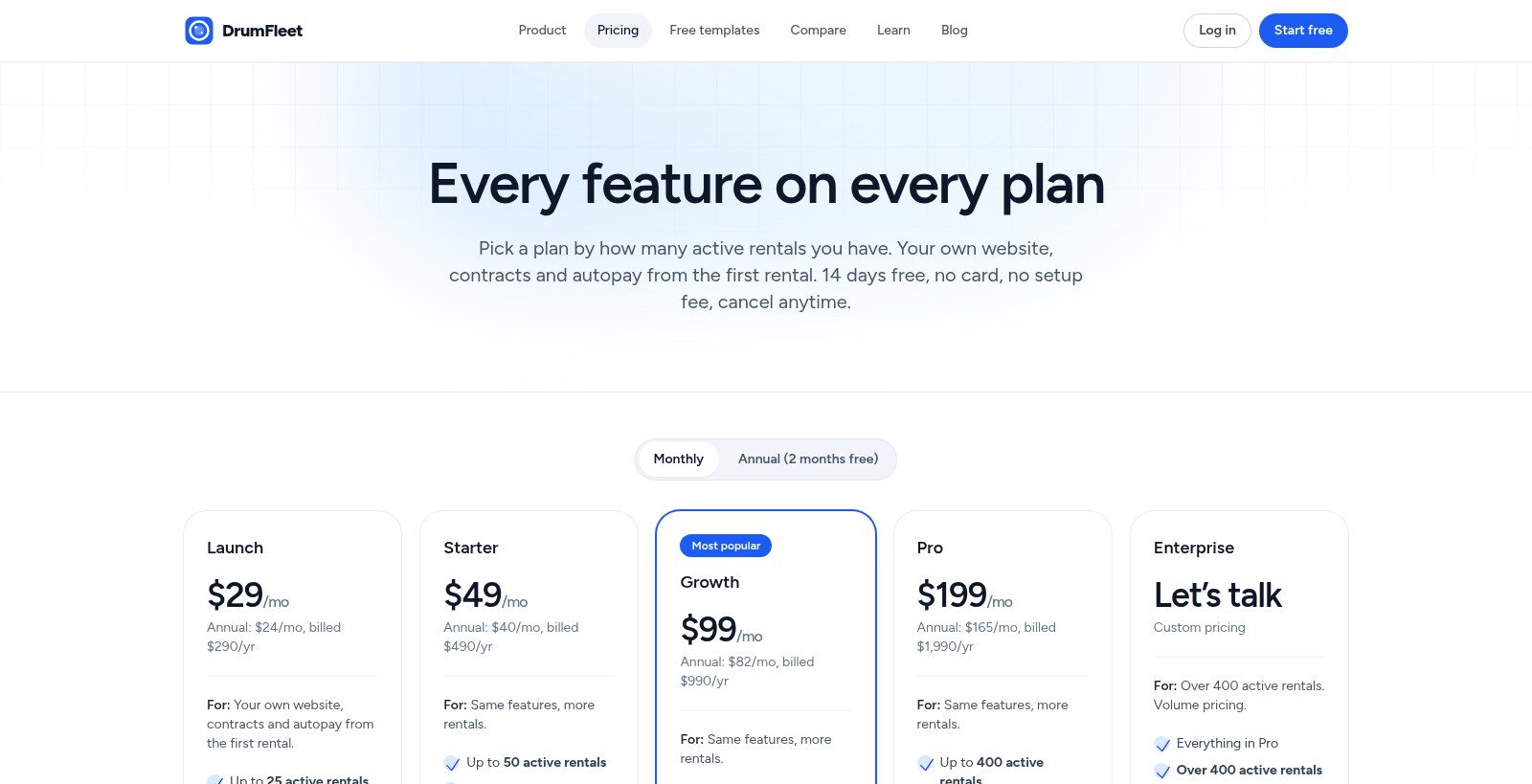
DrumFleet keeps late-fee rules and automatic payment reminders next to the autopay that already runs through your own Stripe account. Same place as the contract and the machine. Plans go by active rentals — Launch $29, Starter $49, Growth $99, Pro $199 — with every feature on every plan (pricing).
If you want to see a grace window and a reminder fire without building it in a Notes app, try DrumFleet: 14-day free trial with every feature, no card. Either way — stop renegotiating the fee in the parking lot.